
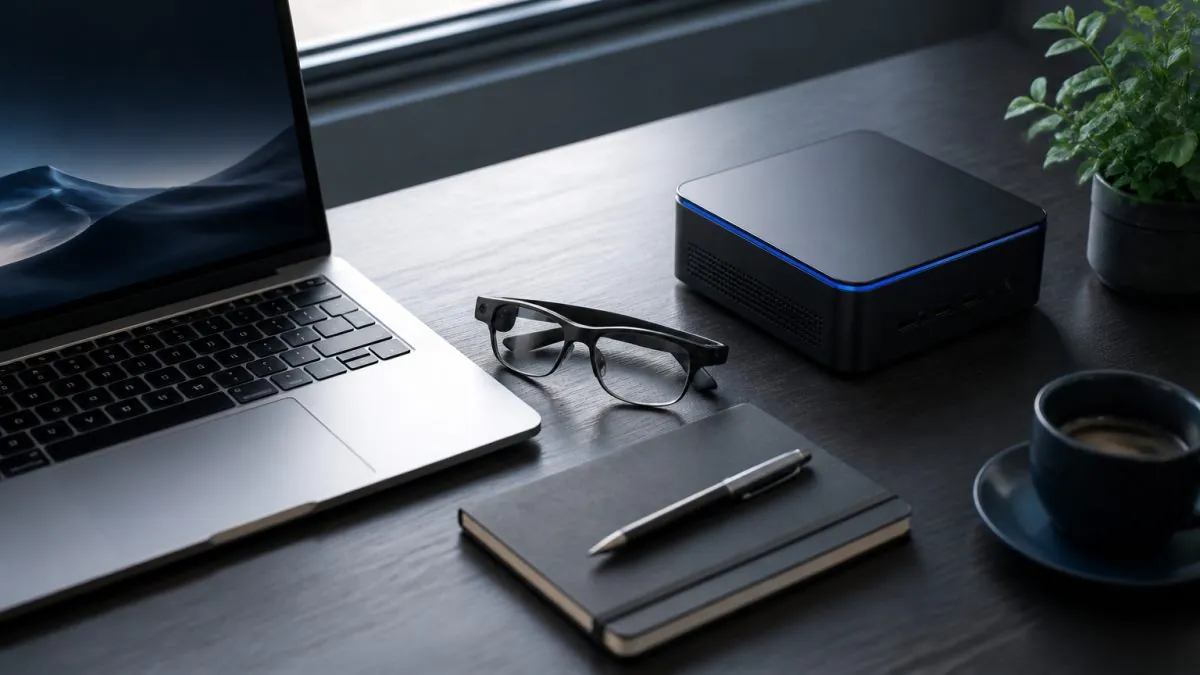
Three Devices, One Direction
Consumer technology in 2026 is being reshaped by one force: on-device intelligence. The clearest sign is where computing power is heading — into laptops, into compact desktops, and even onto your face. Three product categories are leading the way: laptops with dedicated AI hardware, mini PCs that deliver desktop power in tiny packages, and AI glasses that are finally finding practical uses.
The AI Laptop Becomes the Standard
In 2026, the AI laptop is no longer a premium curiosity — it is becoming the default choice for work and study.
On-Device AI and Dedicated Processors
Modern laptops increasingly include dedicated neural processing units that run AI features locally instead of relying on cloud servers. That means real-time transcription, background noise removal, smart photo editing, and AI-assisted writing tools work smoothly even without an internet connection. For students and professionals who handle sensitive data, processing everything on the device is also a privacy advantage.
Battery Life and Display Quality
Alongside AI features, efficiency is the other big story. The latest processors deliver meaningful battery gains, and high-resolution displays with good color accuracy are now common even at mid-range prices. When you compare models, treat battery life and screen quality as core specs — they shape the daily experience far more than benchmark numbers alone.
Mini PCs Move Upmarket
Mini PCs have quietly become one of the fastest-growing categories in desktop computing. Their appeal is obvious: full desktop performance in a chassis small enough to mount behind a monitor.
Business and Signage Deployments
For offices, schools, and retail environments, the mini PC is the practical fleet machine. It consumes less power than a tower, takes up almost no space, and can be standardized across dozens of workstations at a predictable cost per seat. Digital signage, kiosks, and conference-room systems are also heavy users of the category, where reliability and a small footprint matter more than raw speed.
New Performance Ceilings
This year’s models push the category further. High-end mini PCs now handle creative workloads and light gaming that were once reserved for much larger machines, while still running cool and quiet. If your work is browser-based, office-oriented, or media-focused, a well-configured mini PC will likely outperform an older desktop tower at a similar price.
AI Glasses Find Real Use Cases
After years of hype, AI glasses are arriving at a genuinely useful stage. The most popular models now focus on practical, everyday functions rather than futuristic displays.
Translation, Navigation, and Hands-Free Help
Real-time translation displayed in your field of view helps travelers and business people communicate across languages. Turn-by-turn navigation keeps cyclists and walkers looking forward instead of at a phone. And hands-free note-taking or photo capture supports workers in warehouses, clinics, and other settings where holding a device is impractical.
What to Look For
When evaluating AI glasses, prioritize battery life, comfort, and the quality of the core features you will actually use. Audio quality and camera performance matter more than the number of features listed on the box. As with laptops and mini PCs, the devices that succeed are the ones that fit into daily routines without demanding attention.
What These Trends Mean for Buyers
For individual buyers, 2026 is a good year to upgrade. AI-capable laptops, capable mini PCs, and useful smart glasses are all available at more accessible prices than a year ago. The key is matching the device to the task: a laptop for mobility, a mini PC for a fixed workspace, and AI glasses for hands-free moments in between.
For businesses and resellers, the picture is equally clear. Demand is moving toward intelligent, space-saving hardware that lowers total cost of ownership. Standardizing on AI-enabled laptops and mini PCs across a team simplifies support, while AI glasses are opening new possibilities in field work and customer service. Suppliers that can offer consistent quality, configuration flexibility, and dependable supply are best positioned to serve this growing demand.
The direction of 2026 is simple: intelligence is moving out of the cloud and into the devices we carry and use every day. Choosing hardware that embraces that shift — an AI laptop, a capable mini PC, or a pair of practical AI glasses — is a decision that will keep paying off for years.
