
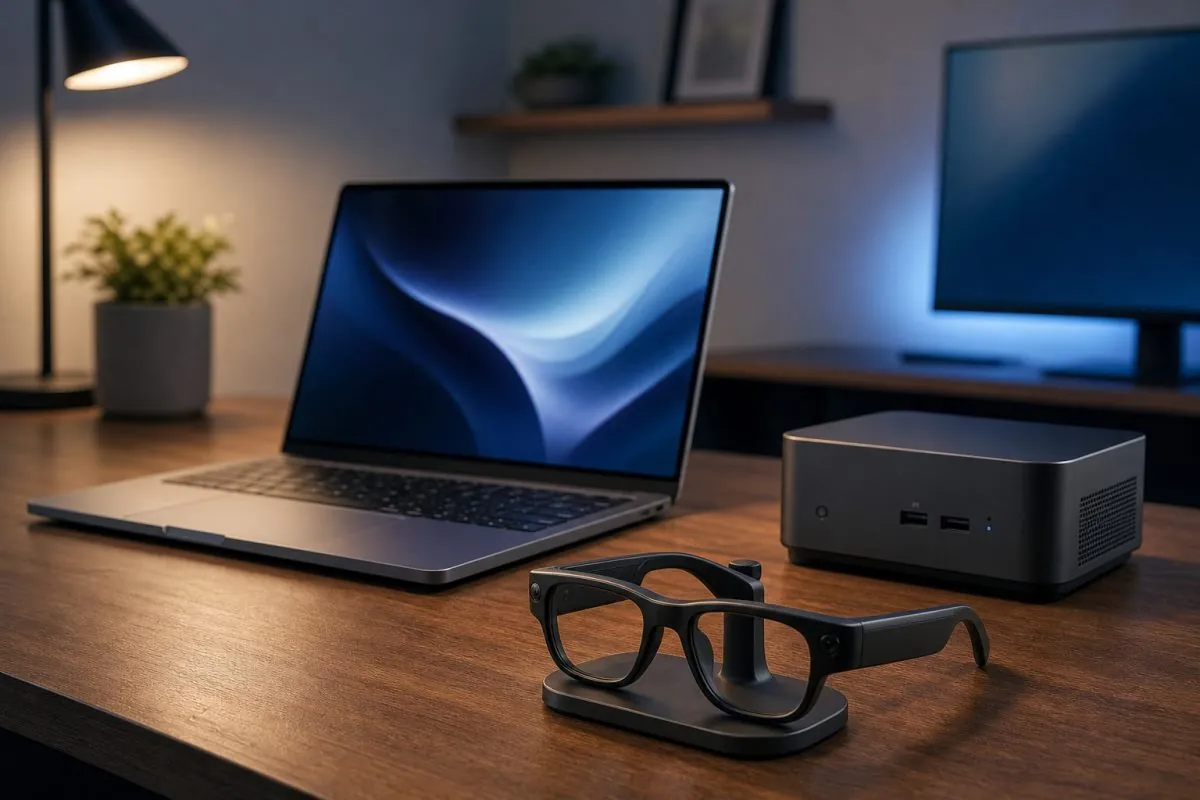
Why On-Device AI Became the Defining Trend of 2026
For most of this decade, “AI” in consumer tech meant a connection to a cloud service. In 2026, the emphasis has shifted to on-device AI – models and features that run locally on the hardware. The reasons are practical: local processing is faster, works without an internet connection, keeps private data on the device, and avoids ongoing cloud subscription costs. This shift is reshaping the three product categories that matter most to wholesale buyers: laptops, mini PCs, and AI glasses.
AI Laptops Move Beyond the Buzzword
The laptop market has absorbed on-device AI faster than almost any other category. Modern AI laptops ship with dedicated neural processing units (NPUs) that handle tasks such as real-time background blur in video calls, automatic noise removal in audio, live translation, and on-device assistants that can summarize documents without uploading them. For end users, the practical benefits are longer battery life – because simple tasks no longer wake the main processor – and smoother multitasking in daily office work.
What to Check on an AI Laptop Spec Sheet
- NPU performance, usually measured in TOPS – a higher number means larger models can run locally
- Memory and storage: 16 GB RAM is increasingly the entry point for comfortable AI use
- Battery and thermal design, since sustained AI workloads generate heat
- Port selection and docking compatibility for office setups
Mini PCs Become Quiet AI Workhorses
Mini PCs are finding a second life as always-on edge devices. Because they are compact, silent, and energy-efficient, they are a natural home for local AI inference at home and in small businesses: running private chatbots and document search, powering digital signage and kiosks, serving as media centers with AI upscaling, or acting as home automation hubs. The 2026 mini PC buyer is no longer only a space-saver – they are often looking for a small machine that quietly handles AI workloads around the clock.
AI Glasses Bring the Interface Closer
AI glasses represent the fastest-moving form factor in the category. The current generation focuses on usefulness rather than spectacle: hands-free voice assistance, real-time translation subtitles, navigation prompts, and camera-based scene recognition, all in a lightweight frame. Battery life, comfort, and privacy features are the deciding factors for most buyers, and the products that perform well at retail are the ones with simple setup and clear on-device privacy controls.
What These Trends Mean for Wholesale Buyers
For distributors and resellers, the on-device AI trend changes how products should be selected and presented:
- Prioritize spec sheets that clearly state AI capability – NPU class, RAM, and storage are now headline figures.
- Stock configurations that balance performance with price: mid-range AI laptops and mini PCs capture the widest demand.
- Expect more questions about privacy and data handling, and have clear answers ready for both consumers and business clients.
- Plan documentation and support in multiple languages, since AI features often need setup guidance beyond the box.
- Watch the compatibility story: peripherals, docks, and software ecosystems matter as much as raw specs.
Conclusion
On-device intelligence is no longer a feature – it is becoming the baseline expectation across laptops, mini PCs, and AI glasses. Buyers who understand the trend can build assortments that answer real user needs: speed, privacy, and usefulness without a constant internet connection. The products that win in 2026 are the ones that make AI feel simple, practical, and affordable.
